



CONFLICT WATCH — Gaza and accountability · Explainer
A United Nations Commission of Inquiry concluded in September 2025 that Israel committed genocide against Palestinians in Gaza. Separately, the International Criminal Court issued an arrest warrant for Benjamin Netanyahu for alleged war crimes and crimes against humanity. These are consequential findings and proceedings, but they involve different institutions, different legal questions and different stages of accountability.
This explainer opens The Northern Current’s continuing conflict coverage. It explains existing findings; it does not present the September 2025 report or November 2024 warrant as newly issued today.
What the UN commission found
The UN Independent International Commission of Inquiry on the Occupied Palestinian Territory, including East Jerusalem, and Israel announced its genocide conclusion on September 16, 2025. Its report examines Israeli conduct in Gaza under the Genocide Convention. The finding should be attributed to that commission rather than described as a verdict delivered by every institution within the United Nations.
A commission’s investigative conclusion is distinct from a final judgment by an international court. That distinction does not erase the finding: readers should be told plainly what the investigators concluded and be able to inspect the underlying report.
What Netanyahu’s arrest warrant means
The ICC issued the warrant on November 21, 2024. Its judges found reasonable grounds to believe Netanyahu and former defence minister Yoav Gallant bore responsibility for the war crime of starvation as a method of warfare and the crimes against humanity of murder, persecution and other inhumane acts.
The warrant concerns alleged conduct from at least October 8, 2023, through May 20, 2024. It is an arrest warrant based on the court’s stated evidentiary threshold, not a conviction following a criminal trial. Describing Netanyahu as wanted by the ICC for alleged war crimes and crimes against humanity accurately identifies that status.
The separate case against Israel
South Africa’s case against Israel at the International Court of Justice concerns obligations under the Genocide Convention. The ICJ deals with state responsibility; the ICC prosecutes individuals. Their proceedings must not be collapsed into a single case.
In a June 2, 2026 statement, South Africa’s presidency reported that an ICJ order set November 22, 2027 for South Africa’s next written pleading and May 22, 2029 for Israel’s response. That statement describes procedural deadlines, not a final genocide judgment.
Israel rejects the genocide accusation and says its military campaign is directed at Hamas following the October 7, 2023 attacks. Reuters reported that position in its September 18, 2025 explainer. Reporting the response alongside the findings allows readers to see both the allegation and the defence without treating either as an adjudicated criminal conviction.
What TNC will follow
Our continuing coverage will examine civilian conditions, humanitarian access, displacement, journalists’ safety, accountability proceedings and Canada’s response. Interviews with local journalists and Canadian community organizations will be identified as such when obtained; this article contains no original interviews.
Sources: UN commission announcement, September 16, 2025; commission report; ICC warrant announcement, November 21, 2024; ICC Netanyahu case page; South African presidency, June 2, 2026; Reuters explainer, September 18, 2025.
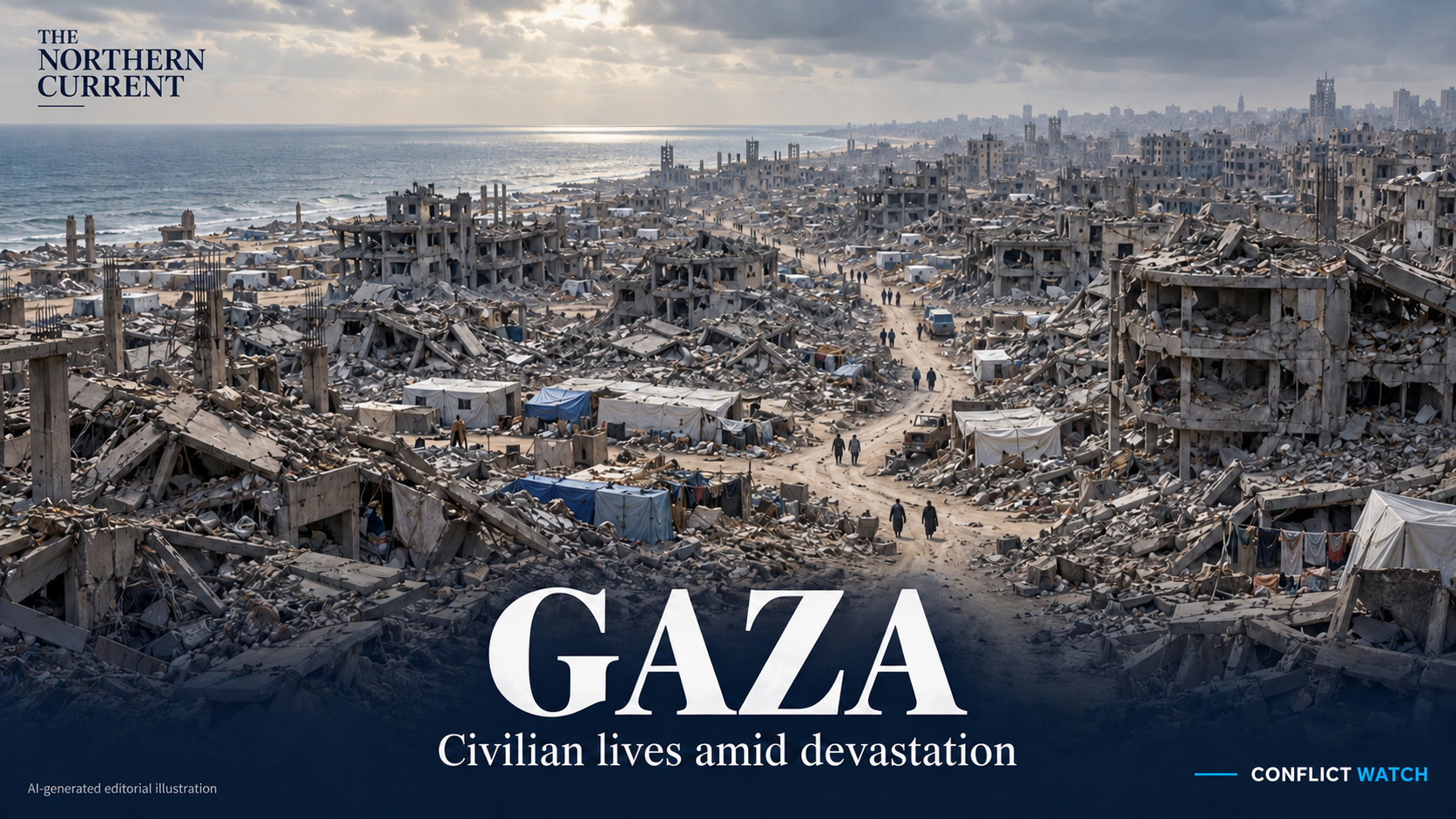
Cover: AI-generated editorial illustration of Gaza’s devastation. It does not document a particular location or incident and does not depict the West Bank.
.jpg)

.jpg)
Leave a comment
Join the discussion. Please follow our Community Standards.
Sign in or create an account to leave a comment.
Use your ChatGPT account to comment. Choose your public display name before submitting.
No published comments yet.